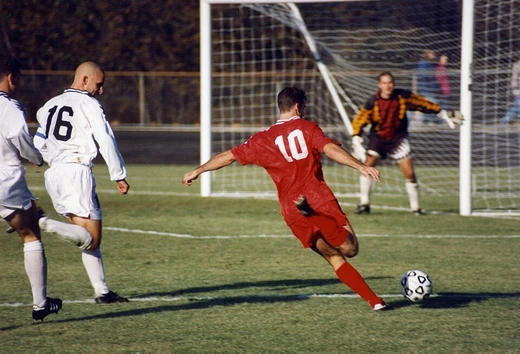
Abby Wambach
American forward, fourth all-time in international goals, 2012 FIFA Player of the Year.

Wikipedia / Wikimedia Commons
Mary Abigail Wambach (born June 2, 1980) is an American former professional soccer player who played as a forward. She played for the U.S. women's national soccer team from 2001 to 2015, scoring 184 international goals, ranking fourth on the all-time list of international goals scored by players of any gender, behind Cristiano Ronaldo, Ali Daei, and Lionel Messi. A six-time U.S. Soccer Athlete of the Year and the 2012 FIFA World Player of the Year, she was included on the 2015 Time 100 list of the most influential people in the world.
- born
- June 2, 1980
- field
- Soccer (forward)
- nationality
- American
- known_for
- 184 international goals; diving headers; 2011 World Cup last-minute equalizer against Brazil
Lore & Background
Wambach was born to Pete and Judy Wambach in Rochester, New York, and raised in the suburb of Pittsford. The youngest of seven children, she began playing soccer at age four after her sister Laura tried the sport. Her mother checked out a library book on how to play, and soccer became a family tradition. Wambach credited her large family for teaching her to compete, noting that her siblings never let her win. She was toughened by her elder brothers, who fired hockey pucks at her for target practice. At age five, after scoring 27 goals in a single season in her first youth league, she was transferred from the girls' team to the boys' team. As a pre-teen, she eluded defenders by heading the ball over them and running around them.
In college, Wambach accepted a full athletic scholarship to the University of Florida, where she played for the Florida Gators from 1998 to 2001. She helped the Gators win their first NCAA national championship in 1998, defeating the 14-time champion North Carolina Tar Heels. She set school career records for goals (96), assists (49), points (241), game-winning goals (24), and hat tricks (10). She was inducted into the University of Florida Athletic Hall of Fame as a 'Gator Great' in 2012.
Professionally, Wambach played for Washington Freedom, magicJack, and the Western New York Flash. She was selected first overall in the 2002 WUSA draft by the Washington Freedom, where she was named WUSA Rookie of the Year and later scored the game-winning goal in the 2003 Founders Cup. In 2011, she scored a last-minute equalizer against Brazil in the World Cup quarterfinal, a diving header from a Megan Rapinoe cross that set a record for the latest goal ever scored in a World Cup match and won the ESPY Award for Best Play of the Year.
Reader's Guide
Abby Wambach's significance lies in her prolific goal-scoring and her role in elevating women's soccer in the United States. With 184 international goals, she ranks second all-time among players of any gender, a testament to her consistency and finishing ability. Her six U.S. Soccer Athlete of the Year awards and the 2012 FIFA World Player of the Year honor underscore her dominance during her career. Wambach competed in four FIFA Women's World Cups, winning in 2015, and earned Olympic gold medals in 2004 and 2012. Her trademark diving headers, particularly the 2011 World Cup equalizer against Brazil, became iconic moments in sports history. Beyond the field, her autobiography 'Forward' and her book 'Wolfpack' both became New York Times Best Sellers, extending her influence as a speaker and author. Wambach's legacy includes inspiring a generation of players and fans, and her induction into the University of Florida Athletic Hall of Fame reflects her collegiate impact. Her retirement in 2015 after the Victory Tour marked the end of a career that reshaped expectations for women's soccer.
Did You Know?
- Wambach was transferred from a girls' youth team to a boys' team at age five after scoring 27 goals in a single season.
- She scored a last-minute equalizer against Brazil in the 2011 World Cup quarterfinal, which set a record for the latest goal ever scored in a World Cup match.
- Wambach was named Athlete of the Year by the Associated Press in 2011, becoming the second soccer player (after Mia Hamm) to receive the honor, as the award is for U.S.-based athletes.
- Both of her books, 'Forward' (2016) and 'Wolfpack' (2019), became New York Times Best Sellers.
More in Soccer 1-24
Elsewhere in the Soccer universe
Spotted an error? Know more?
This is a living reference — every entry is fact-audited, and reader corrections feed straight into our audit queue. Suggest an edit · See this site's audit record